Education Investment: 2026 ROI for US Degree Paths

Advertisers
Understanding the average 2026 Return on Investment (ROI) for different US degree paths is crucial for making informed educational and career decisions, helping students maximize their future earnings and professional growth.
Advertisers
Considering higher education is a significant decision, and in today’s rapidly evolving economic landscape, understanding the education investment ROI is more critical than ever. As we look towards 2026, prospective students and their families in the US are keenly interested in which degree paths offer the most promising financial returns and career stability. This article delves into the projected average Return on Investment for various educational routes, providing insights to help you make informed choices.
Advertisers
The evolving landscape of education ROI
The value of a degree has always been a topic of discussion, but with rising tuition costs and a dynamic job market, the conversation around Return on Investment (ROI) for higher education has intensified. In 2026, the traditional view of a linear career path following a specific degree is being challenged by the need for adaptability and continuous learning. Students are increasingly seeking clarity on how their educational choices will translate into tangible financial benefits and long-term career satisfaction.
Economic shifts, technological advancements, and changing industry demands are all factors that influence the ROI of different degree paths. What was a high-demand field a decade ago might be saturated today, while emerging technologies create entirely new opportunities. Therefore, a forward-looking perspective, such as evaluating ROI for 2026, becomes essential for strategic planning.
Defining ROI in education
- Financial Return: This primarily refers to the increased earning potential and career advancement opportunities directly attributable to a specific degree. It involves comparing lifetime earnings with and without the degree, factoring in tuition, fees, and foregone earnings during study.
- Non-Financial Benefits: Beyond monetary gains, education offers invaluable benefits like critical thinking skills, expanded networks, personal growth, and enhanced civic engagement. While harder to quantify, these contribute significantly to overall life quality.
- Time Horizon: ROI calculations often consider various timeframes, from immediate post-graduation earnings to long-term career trajectory and retirement savings. A degree with a lower immediate ROI might offer substantial long-term benefits.
Understanding these multifaceted aspects of educational ROI allows for a more comprehensive evaluation, moving beyond mere salary comparisons to a holistic view of a degree’s worth. This section sets the stage for a deeper dive into specific degree paths.
Associate degrees: practical skills and quick entry
Associate degrees, typically two-year programs offered by community colleges and technical schools, represent a practical and often more affordable entry point into specialized careers. For many, they offer a faster path to employment and a solid foundation for further education. The ROI for associate degrees in 2026 remains strong in specific vocational fields.
These programs are designed to equip students with specific, in-demand skills, making them attractive to employers seeking qualified candidates without the longer commitment of a bachelor’s degree. The lower tuition costs and shorter duration mean less debt and earlier entry into the workforce, contributing to a quicker positive ROI.
High-demand associate degree fields
- Healthcare Support: Fields like registered nursing (RN), dental hygiene, and medical assisting consistently show strong employment growth and competitive salaries, offering excellent ROI.
- Skilled Trades: HVAC technology, automotive repair, and welding provide essential services and often lead to well-paying jobs with high demand, particularly as experienced workers retire.
- Information Technology: Programs in cybersecurity, network administration, and web development offer pathways into rapidly expanding tech sectors, often with opportunities for continued professional development and credentialing.
While the earning potential might not reach that of some bachelor’s degree holders, the lower initial investment and rapid entry into the job market make associate degrees a compelling option for a significant portion of the US workforce in 2026. Many graduates also use their associate degree as a stepping stone to a bachelor’s, often transferring credits to reduce overall costs.
Bachelor’s degrees: the traditional pathway to career growth
The bachelor’s degree remains the most common and widely recognized credential in the US, often seen as a prerequisite for many professional roles. In 2026, a bachelor’s degree continues to offer a substantial earnings premium over a high school diploma or even an associate degree, though the ROI varies significantly by major and institution.
A four-year degree typically provides a broader educational foundation, fostering critical thinking, communication, and problem-solving skills that are highly valued across diverse industries. The networking opportunities and career services often available at universities also contribute to a stronger career launch and long-term trajectory.
ROI variations by bachelor’s major
Not all bachelor’s degrees are created equal in terms of financial ROI. STEM fields (Science, Technology, Engineering, and Mathematics) generally lead the pack due to high demand and specialized skill sets. Business and healthcare-related majors also consistently show strong returns.
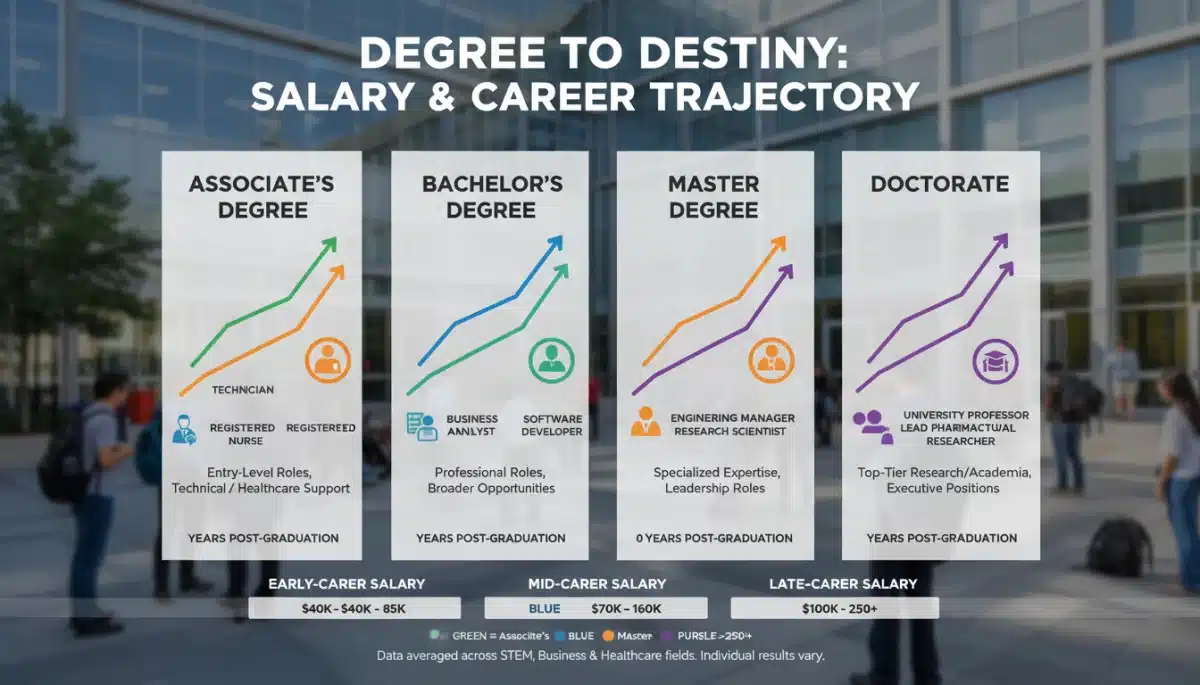

- Engineering: Disciplines like computer engineering, electrical engineering, and mechanical engineering consistently rank among the highest-earning majors, with strong job prospects and continuous innovation.
- Computer Science: With the digital transformation accelerating, computer science graduates are in high demand for roles in software development, data science, and cybersecurity, commanding competitive salaries.
- Healthcare (e.g., Nursing, Health Sciences): While some healthcare roles require advanced degrees, many entry-level professional positions with excellent growth potential are accessible with a bachelor’s, such as registered nurses or health information managers.
- Business (e.g., Finance, Accounting): Business degrees provide versatile skills applicable across various sectors, with finance and accounting often leading to stable and lucrative careers.
Conversely, some humanities and arts degrees may offer a lower immediate financial ROI, though they provide immense value in other aspects, such as fostering creativity, cultural understanding, and critical analysis. However, graduates in these fields often find success by combining their foundational skills with practical experience or by pursuing interdisciplinary studies.
Graduate degrees: specialized expertise and leadership roles
Graduate degrees, including master’s and doctoral programs, are pursued for specialized knowledge, career advancement, and entry into research or academic fields. For 2026, these degrees often yield the highest lifetime earnings, but they also come with a significant investment in time and money.
The ROI for graduate degrees is typically found in the increased earning potential, access to leadership positions, and the ability to work in highly specialized or research-intensive roles. The additional years of study and accumulated debt mean the financial break-even point might be further out, but the long-term benefits can be substantial.
Master’s and doctoral ROI hotspots
- Master of Business Administration (MBA): A well-regarded MBA program can significantly boost career trajectories and earning potential, especially for those aiming for executive or senior management roles.
- Medical and Health Specialties: Doctors, dentists, and specialized healthcare professionals consistently command top salaries, reflecting the extensive education and critical services they provide.
- Law Degrees (JD): While the legal market can be competitive, lawyers in specialized and high-demand areas can achieve very high earnings, making the JD a strong ROI investment for many.
- STEM Master’s and PhDs: Advanced degrees in engineering, computer science, and data science open doors to research and development, advanced technical roles, and academic positions, often with excellent compensation.
It’s crucial for prospective graduate students to carefully weigh the costs against the potential career benefits and personal aspirations. The choice of program, institution, and career field plays a paramount role in determining the ultimate ROI of a graduate degree in 2026.
Vocational training and certifications: targeted skills for immediate employment
Beyond traditional degree paths, vocational training and professional certifications offer highly targeted skills for immediate entry into specific trades and technical professions. In 2026, these options continue to provide excellent ROI due to their short duration, lower cost, and direct alignment with labor market needs.
These programs are often ideal for individuals seeking to quickly acquire job-ready skills, transition careers, or upgrade existing qualifications. They typically involve hands-on training and are focused on practical application, making graduates highly employable upon completion.
Key areas for vocational ROI
- Certified Trades: Electricians, plumbers, and carpenters are always in demand, and certification programs offer a direct route to these stable and well-paying professions.
- IT Certifications: CompTIA, Cisco, and Microsoft certifications, among others, can validate specialized IT skills, leading to roles in network administration, cybersecurity, and cloud computing.
- Healthcare Certifications: Certified nursing assistants (CNAs), phlebotomists, and medical coders can enter the healthcare field quickly through certification programs, often with opportunities for further education.
The appeal of vocational training and certifications lies in their efficiency. They minimize the time and financial investment while maximizing the speed to employment and earning capacity, offering a strong ROI for those looking for a direct path to a skilled career.
Factors influencing education ROI beyond degree type
While the type of degree is a significant determinant of ROI, several other factors play a crucial role in maximizing the return on your education investment. These considerations are vital for any student planning their academic and professional future in 2026.
Understanding these broader influences allows for a more nuanced approach to educational planning, recognizing that a degree is just one piece of a larger puzzle. Strategic choices in these areas can significantly enhance the financial and personal benefits derived from higher education.
Crucial considerations for maximizing ROI
- Institution Reputation and Network: Prestigious institutions often provide better networking opportunities, stronger career services, and a more recognized credential, which can translate to higher starting salaries and faster career progression.
- Geographic Location: The job market and cost of living vary significantly by region. Pursuing a degree in an area with strong demand for your chosen field can enhance employment prospects and earning potential.
- Internships and Experiential Learning: Practical experience gained through internships, co-ops, and apprenticeships is invaluable. It not only builds skills but also creates professional connections and often leads to job offers upon graduation.
- Soft Skills Development: Communication, teamwork, problem-solving, and adaptability are highly valued by employers. Degrees that foster these ‘soft skills’ alongside technical knowledge can significantly improve career outcomes.
- Continuous Learning and Adaptability: The job market in 2026 demands lifelong learning. Graduates who commit to continuous skill development and remain adaptable to industry changes will maintain a higher ROI over their careers.
By strategically considering these factors, students can optimize their educational journey to achieve not just financial success, but also a fulfilling and resilient career path. The interplay of these elements with the chosen degree type ultimately shapes the individual’s long-term ROI.
Navigating student debt and financial aid effectively
One of the most critical aspects of maximizing your education ROI in 2026 is effectively managing student debt and leveraging financial aid. High levels of debt can significantly diminish the net financial return of even a high-earning degree, making careful planning essential.
Understanding the various types of financial aid, including grants, scholarships, work-study programs, and loans, is paramount. Prioritizing ‘free money’ (grants and scholarships) over loans can drastically reduce the overall cost of education and improve your ROI.
Strategies for debt management and financial optimization
- Maximize Grants and Scholarships: Actively search and apply for as many grants and scholarships as possible, as these do not need to be repaid. Many are merit-based, while others are need-based or specific to certain demographics or fields of study.
- Understand Loan Types: Differentiate between federal and private loans. Federal loans often come with more flexible repayment options and lower interest rates. Only borrow what is absolutely necessary.
- Consider In-State Tuition: Attending a public university in your home state can significantly reduce tuition costs compared to out-of-state or private institutions, thereby improving your financial outlook post-graduation.
- Work While Studying: Part-time jobs, especially those related to your field of study, can help offset living expenses and tuition, reducing the need for loans while also providing valuable work experience.
- Financial Literacy: Develop a strong understanding of personal finance, budgeting, and debt repayment strategies. This knowledge will be crucial for managing your finances during and after your education.
Proactive financial planning and disciplined debt management are as important as choosing the right degree path when it comes to realizing a strong ROI on your education investment. By minimizing debt and strategically utilizing available aid, students can ensure their educational gains are not overshadowed by financial burdens.
| Degree Path | 2026 ROI Outlook |
|---|---|
| Associate Degrees | Strong in skilled trades & healthcare support; quick entry & lower debt. |
| Bachelor’s Degrees | High in STEM, Business, Healthcare; foundational for many professions. |
| Graduate Degrees | Highest lifetime earnings in specialized fields (e.g., medical, advanced tech, MBA). |
| Vocational Training | Excellent ROI for targeted skills; immediate employment, low cost. |
Frequently asked questions about education ROI
A good ROI for education typically means that the increased lifetime earnings and career opportunities significantly outweigh the total cost of tuition, fees, and foregone income during study. It’s a balance between financial gain and personal fulfillment.
While many degrees offer a positive financial ROI over a lifetime, some fields may yield lower monetary returns, especially if not combined with practical experience or further specialization. Non-financial benefits should also be considered in these cases.
To improve your ROI, choose in-demand fields, gain practical experience through internships, network effectively, manage student debt wisely, and continuously develop new skills relevant to your chosen industry.
An advanced degree is generally worth the investment for specialized careers, leadership roles, or research positions where it is a prerequisite. However, it requires careful consideration of costs, time commitment, and career goals.
Location plays a significant role as job market demand, industry presence, and cost of living vary by region. Choosing to study and work in an area with high demand for your skills can substantially boost your education’s ROI.
Conclusion
As we navigate towards 2026, the decision to pursue higher education remains one of the most impactful choices an individual can make. Understanding the average ROI for different US degree paths is not merely about financial gain, but about making strategic decisions that align with personal aspirations and market realities. From the practical entry points of associate degrees and vocational training to the specialized expertise offered by bachelor’s and graduate programs, each path presents a unique value proposition. By carefully considering the type of degree, institutional factors, experiential learning, and effective financial management, students can significantly enhance their educational investment, paving the way for a prosperous and fulfilling future. The landscape of education is dynamic, but with informed choices, maximizing your education investment is an achievable goal.
