Online Degree Accreditation 2026: Avoid Pitfalls in the US
Advertisers
Understanding the 2026 landscape of online degree accreditation is paramount for US students to avoid pitfalls, ensuring their chosen programs are legitimate, recognized, and provide true educational value.
The pursuit of higher education has evolved dramatically, with online learning becoming an increasingly popular and accessible pathway for millions of students across the United States. However, as the digital learning environment expands, so too does the complexity surrounding program legitimacy and recognition. For US students, understanding online degree accreditation in 2026 is not merely a formality; it is a critical safeguard against investing time and resources into unrecognized or even fraudulent educational offerings. This guide aims to equip you with the essential knowledge to navigate this intricate landscape, identify reputable institutions, and avoid the common pitfalls that can derail your academic and professional aspirations.
Understanding the Basics of Accreditation in 2026
Accreditation serves as a quality assurance process, signifying that an educational institution or program meets established standards of excellence. In the US, this process is voluntary but highly respected, acting as a crucial indicator of an institution’s credibility and the value of its degrees. For online education, the principles remain the same, but the delivery method introduces unique considerations that students must be aware of.
The year 2026 brings with it an evolved regulatory environment and technological advancements that further shape how accreditation bodies operate and how online programs are evaluated. Staying informed about these foundational aspects is the first step toward making wise educational choices.
Anúncios
What is Accreditation and Why Does It Matter?
Accreditation is a peer-review process where educational institutions or programs are evaluated by an external agency to determine if they meet a set of rigorous quality standards. This assessment covers various aspects, including curriculum, faculty qualifications, student services, financial stability, and learning outcomes. For students, accreditation holds immense significance.
- Financial Aid Eligibility: Only students enrolled in accredited institutions are eligible for federal financial aid, including grants, loans, and work-study programs.
- Transfer of Credits: Credits earned at accredited institutions are generally transferable to other accredited schools, facilitating academic mobility.
- Employment Opportunities: Many employers and licensing boards require applicants to hold degrees from accredited institutions, impacting career prospects.
- Graduate School Admission: Admission to reputable graduate programs often necessitates an undergraduate degree from an accredited institution.
In essence, accreditation is the bedrock of educational legitimacy, ensuring that your degree holds currency and respect in both academic and professional spheres. Without it, your educational investment might be rendered worthless.
The Different Types of Accreditation Bodies in the US
The US accreditation system is decentralized and complex, involving several types of accrediting agencies recognized by the Council for Higher Education Accreditation (CHEA) and the U.S. Department of Education (USDE). Understanding these distinctions is vital for online students, as the type of accreditation can significantly impact degree recognition and transferability.
As we move into 2026, these distinctions remain critical, with increased scrutiny on how these bodies adapt their standards to the evolving online learning landscape. Students need to be particularly discerning about which type of accreditation their prospective online program holds.
Anúncios
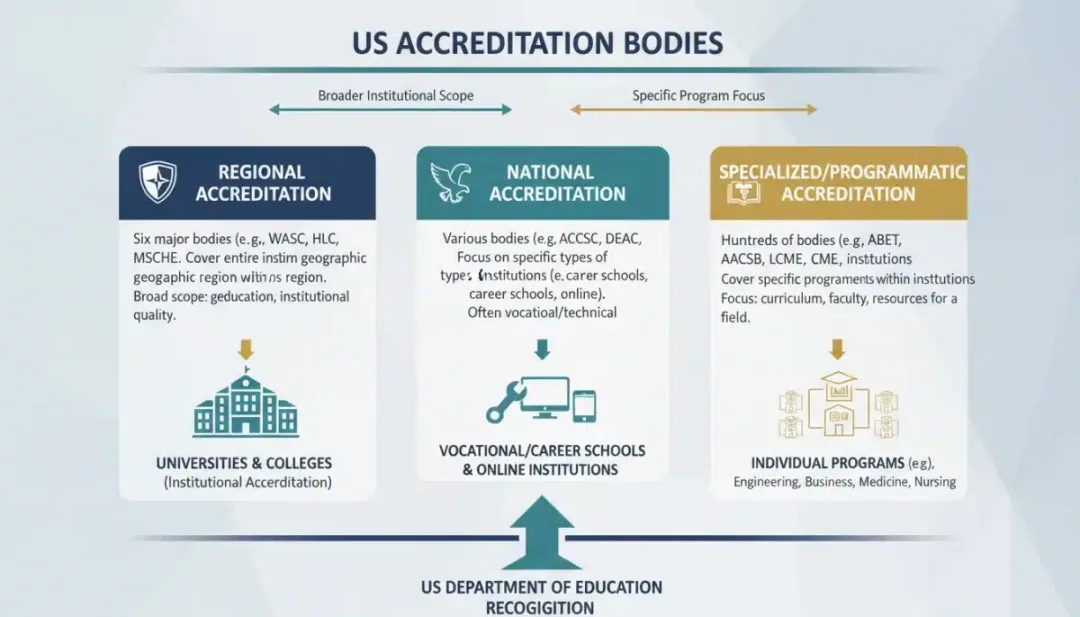
The two primary categories of institutional accreditation are regional and national. Additionally, specialized or programmatic accreditation exists for specific fields of study.
Regional vs. National Accreditation
Historically, regional accreditation has been considered the gold standard, associated with traditional, non-profit colleges and universities. These agencies accredit entire institutions within specific geographic regions.
- Regional Accreditors: These are generally seen as more academically rigorous and are widely accepted for credit transfer and graduate school admissions. Examples include the Middle States Commission on Higher Education (MSCHE) and the WASC Senior College and University Commission (WSCUC).
- National Accreditors: Often accredit vocational, technical, career, and for-profit institutions across the nation. While legitimate, degrees from nationally accredited schools may face challenges when transferring credits to regionally accredited institutions or when seeking admission to certain graduate programs.
In 2026, while the lines between regional and national accreditation have blurred somewhat due to policy changes encouraging more flexibility, regional accreditation generally still carries more weight for broad academic recognition. Students pursuing online degrees should prioritize institutions with regional accreditation if their long-term goals include transferring credits or pursuing further graduate studies at traditional universities.
Specialized or Programmatic Accreditation
Beyond institutional accreditation, certain programs or departments within an institution may hold specialized or programmatic accreditation. This type of accreditation focuses on the quality of a specific course of study, such as engineering, nursing, or business.
For example, an online engineering program might be accredited by ABET (Accreditation Board for Engineering and Technology), or a nursing program by the Commission on Collegiate Nursing Education (CCNE). This is particularly important for professions that require specific licensure or certifications, as programmatic accreditation often ensures the curriculum meets industry standards.
Identifying Legitimate Online Programs in 2026
With the proliferation of online degree offerings, distinguishing between legitimate and questionable programs can be challenging. In 2026, as technology advances and the online education market continues to grow, students must sharpen their investigative skills to identify reputable institutions. This requires a systematic approach to verifying claims and scrutinizing credentials.
The digital age has unfortunately also made it easier for unaccredited or even fake institutions to appear legitimate. Therefore, due diligence is more important than ever for prospective online students.
Key Steps to Verify Accreditation
The most crucial step in identifying a legitimate online program is to verify its accreditation status. Do not rely solely on an institution’s website claims; always cross-reference information with official sources.
- Check CHEA and USDE Databases: The Council for Higher Education Accreditation (CHEA) and the U.S. Department of Education (USDE) maintain official databases of recognized accrediting agencies and accredited institutions. These are the authoritative sources for verifying an institution’s accreditation status.
- Visit the Accreditor’s Website: Once you identify the accrediting agency, visit their official website. Most accreditors provide a directory of their accredited institutions. Ensure the institution and the specific program you are interested in are listed.
- Inquire Directly: Contact the institution’s admissions office or registrar’s office and ask for specific details about their accreditation, including the name of the accrediting agency and the dates of their accreditation.
Be wary of institutions that claim to be accredited by an agency not recognized by CHEA or USDE, or those that are vague about their accreditation status. Legitimate institutions are transparent about their credentials.
Red Flags and Warning Signs
Several indicators can signal that an online program or institution might not be legitimate. Being aware of these red flags can help you avoid potential scams and unaccredited degrees.
- Guaranteed Degrees or Instant Diplomas: Any institution promising a degree or diploma without requiring significant academic work is likely fraudulent.
- Lack of Transparency: Institutions that are evasive about their physical location, faculty credentials, or accreditation status should be approached with extreme caution.
- High-Pressure Sales Tactics: Aggressive enrollment counselors who push for immediate enrollment and payment without allowing time for research are a warning sign.
- Unsolicited Offers: Be skeptical of unsolicited emails or calls offering degrees based on “life experience” or without academic prerequisites.
- Fees for Accreditation Checks: Legitimate institutions do not charge extra fees for accreditation verification; this information should be readily available.
Always trust your instincts. If something feels too good to be true, it probably is. A thorough investigation is always warranted when considering an online degree program.
Regulatory Changes and Their Impact on Online Accreditation in 2026
The regulatory landscape surrounding online education and accreditation is dynamic, with ongoing efforts to adapt to technological advancements and evolving educational models. In 2026, students can expect to see the continued impact of recent policy shifts and emerging trends that influence how online programs are accredited and recognized.
These changes are often aimed at improving quality, ensuring consumer protection, and fostering innovation in distance learning. Staying abreast of these developments is crucial for making informed decisions about online education.
Evolving Federal and State Oversight
The U.S. Department of Education continues to play a significant role in overseeing accrediting agencies, ensuring they uphold rigorous standards. Recent years have seen discussions around strengthening accountability and transparency in accreditation, particularly concerning online and non-traditional programs.
State authorization is another critical aspect. Institutions offering online programs to students in different states must comply with each state’s regulations. The State Authorization Reciprocity Agreement (SARA) has streamlined this process for many institutions, but it’s still essential to ensure your chosen program is authorized to operate in your state of residence.
Impact of Technology and AI on Accreditation Standards
As artificial intelligence (AI) and other advanced technologies become integral to online learning, accrediting bodies are adapting their standards to evaluate how institutions integrate these tools responsibly and effectively. This includes assessing the ethical use of AI in curriculum development, assessment, and student support.
Accreditors are also scrutinizing institutions’ cybersecurity measures and data privacy policies, given the sensitive nature of student information in online environments. Students should look for programs that demonstrate a commitment to technological integrity and ethical AI practices.
Common Pitfalls and How to Avoid Them
Despite the benefits of online education, students can encounter numerous pitfalls if they are not diligent in their research and decision-making. These challenges range from enrolling in unaccredited programs to misjudging the demands of online learning. Being proactively aware of these issues can save significant time, money, and frustration.
Avoiding these common traps requires careful planning, thorough investigation, and a realistic understanding of what online education entails.
Enrolling in Unaccredited Programs
This is arguably the most significant pitfall. Degrees from unaccredited institutions are often worthless, failing to be recognized by employers, licensing boards, or other educational institutions. Always verify accreditation through official channels before committing.
Misunderstanding Transferability of Credits
Even if an institution is accredited, the transferability of credits between institutions is not always guaranteed, especially between nationally and regionally accredited schools. If you plan to transfer credits, always confirm with both your current and prospective institutions how credits will be accepted.
Underestimating the Rigor of Online Learning
Many students assume online learning is easier or less demanding than traditional in-person education. This is a misconception. Reputable online programs are just as rigorous, if not more so, requiring strong self-discipline, time management skills, and active participation. Assess your learning style and commitment honestly before enrolling.
Falling Victim to Diploma Mills
Diploma mills are fraudulent entities that sell fake degrees or certificates without requiring legitimate academic work. They often use names similar to reputable institutions and may claim dubious accreditation. Always investigate institutions thoroughly, looking for the red flags mentioned earlier.
Maximizing Your Online Degree Investment
Choosing an online degree program is a significant investment in your future. To ensure you maximize this investment, it’s essential to select a program that not only aligns with your academic and career goals but also provides a high-quality, recognized education. This involves looking beyond just the accreditation status and considering the overall value proposition of the program.
In 2026, the competitive job market and evolving industry demands mean that a well-chosen and effectively leveraged online degree can open numerous doors for career advancement and personal growth.
Choosing the Right Program for Your Goals
Consider your long-term career aspirations and how the online degree will contribute to them. Research job market trends and ensure the program’s curriculum is up-to-date and relevant to your chosen field. Look for programs with strong industry connections, internship opportunities, or career services.
Leveraging Online Resources and Support
Reputable online programs offer a wealth of resources, including academic advising, technical support, library services, and career counseling. Actively utilize these resources to enhance your learning experience and support your academic success. Engagement with faculty and peers through online forums and virtual collaboration tools can also enrich your educational journey.
Building Your Professional Network
Online learning doesn’t mean isolation. Actively participate in virtual student organizations, professional associations, and online networking events. Building a strong professional network during your studies can be invaluable for job opportunities, mentorship, and career advancement after graduation.
By carefully selecting an accredited program, engaging fully with the learning community, and leveraging available resources, you can ensure your online degree investment yields significant returns.
The Future of Online Degree Accreditation and Student Success
As we look ahead beyond 2026, the landscape of online degree accreditation will continue to evolve, driven by technological innovation, shifting educational paradigms, and ongoing efforts to ensure quality and accountability. For students, this means a continuous need for vigilance and informed decision-making.
The future promises even more flexible and personalized learning pathways, making the role of robust accreditation even more critical in distinguishing credible opportunities from dubious ones. Embracing lifelong learning and staying informed about educational standards will be key to navigating this future successfully.
Emerging Trends in Online Education
Micro-credentials, competency-based education, and extended reality (XR) integrated learning environments are some of the emerging trends that accrediting bodies are already beginning to address. These innovations offer new ways to learn and demonstrate skills, but their recognition and validation will heavily rely on established accreditation frameworks.
Furthermore, the focus on demonstrable learning outcomes will intensify, pushing institutions to clearly articulate what students will know and be able to do upon completing an online program. This shift benefits students by providing greater transparency and accountability.
Your Role as an Informed Student
Ultimately, the responsibility for avoiding pitfalls in online degree accreditation rests with the student. Be an active and informed consumer of education. Ask critical questions, verify all claims, and consult official sources. Your proactive engagement in the research process is your best defense against educational scams and substandard programs.
By staying informed about the evolving accreditation landscape, understanding the different types of accreditation, identifying red flags, and leveraging available resources, US students can confidently pursue online degrees that are recognized, respected, and truly contribute to their personal and professional growth.
| Key Aspect | Brief Description |
|---|---|
| Accreditation Importance | Ensures program quality, federal aid eligibility, credit transfer, and job recognition. |
| Types of Accreditation | Regional (broadly accepted), National (vocational focus), and Programmatic (field-specific). |
| Verification Steps | Check CHEA/USDE databases, accreditor websites, and directly with the institution. |
| Avoiding Pitfalls | Beware of guaranteed degrees, lack of transparency, and diploma mills. |
Frequently Asked Questions About Online Degree Accreditation
Why is accreditation so important for an online degree?▼Accreditation signifies that an online program meets rigorous quality standards, ensuring your degree is recognized by employers, eligible for federal financial aid, and allows for credit transfer to other institutions. Without it, your educational investment may have little value.
What’s the difference between regional and national accreditation for online programs?▼Regional accreditation is traditionally associated with academic rigor and broader acceptance for credit transfer and graduate studies. National accreditation often applies to vocational or for-profit schools. For online degrees, regional accreditation generally offers more versatile recognition.
How can I verify if an online institution is legitimately accredited?▼Always cross-reference the institution’s claims with official sources like the Council for Higher Education Accreditation (CHEA) or the U.S. Department of Education (USDE) databases. You can also check the specific accreditor’s website for their list of accredited institutions.
Are there any red flags to look out for when choosing an online program?▼Yes, be cautious of programs offering guaranteed degrees, lacking transparency about accreditation or faculty, using high-pressure sales tactics, or making unsolicited degree offers based on minimal experience. These are common signs of unaccredited or fraudulent entities.
How do regulatory changes in 2026 affect online degree seekers?▼Regulatory changes in 2026 emphasize accountability and quality in online education. Students should ensure programs comply with state authorization requirements and that institutions responsibly integrate new technologies like AI, ensuring data privacy and ethical practices.
Conclusion
Navigating the complex landscape of online degree accreditation in 2026 is an essential endeavor for US students seeking to advance their education and careers. The digital learning environment offers unparalleled flexibility and access, but it also necessitates a diligent approach to verifying the legitimacy and quality of educational programs. By understanding the foundational role of accreditation, discerning between different accrediting bodies, meticulously verifying institutional claims, and recognizing common pitfalls, students can make informed decisions that safeguard their future. An accredited online degree is not just a credential; it is a recognized pathway to opportunities, ensuring that your hard work and investment yield valuable returns in both the academic and professional worlds. Remain vigilant, stay informed, and choose wisely to build a strong foundation for your educational journey.