Social Security 2026: Benefit Adjustments for 65 Million Retirees

Advertisers
Social Security 2026 adjustments will impact over 65 million retirees through cost-of-living allowances and other statutory changes, requiring beneficiaries to understand their evolving financial landscape.
Advertisers
Are you one of the millions of Americans relying on Social Security benefits? The Social Security 2026 adjustments are on the horizon, bringing significant implications for over 65 million retirees. Understanding these upcoming changes is crucial for effective financial planning and ensuring your retirement security. Let’s delve into what these adjustments might entail and how they could shape your future.
Understanding the Social Security System’s Foundation
Before we explore the specifics of the 2026 adjustments, it’s essential to grasp the fundamental principles governing Social Security. This program, established in 1935, serves as a vital safety net for millions of Americans, providing retirement, disability, and survivor benefits. Its structure is complex, influenced by economic indicators, demographic shifts, and legislative actions.
Advertisers
The system operates on a pay-as-you-go basis, meaning current workers’ contributions largely fund current retirees’ benefits. This intergenerational contract forms the backbone of Social Security, but it also creates inherent vulnerabilities to economic fluctuations and demographic changes, such as declining birth rates and increased life expectancy.
How Benefits are Calculated
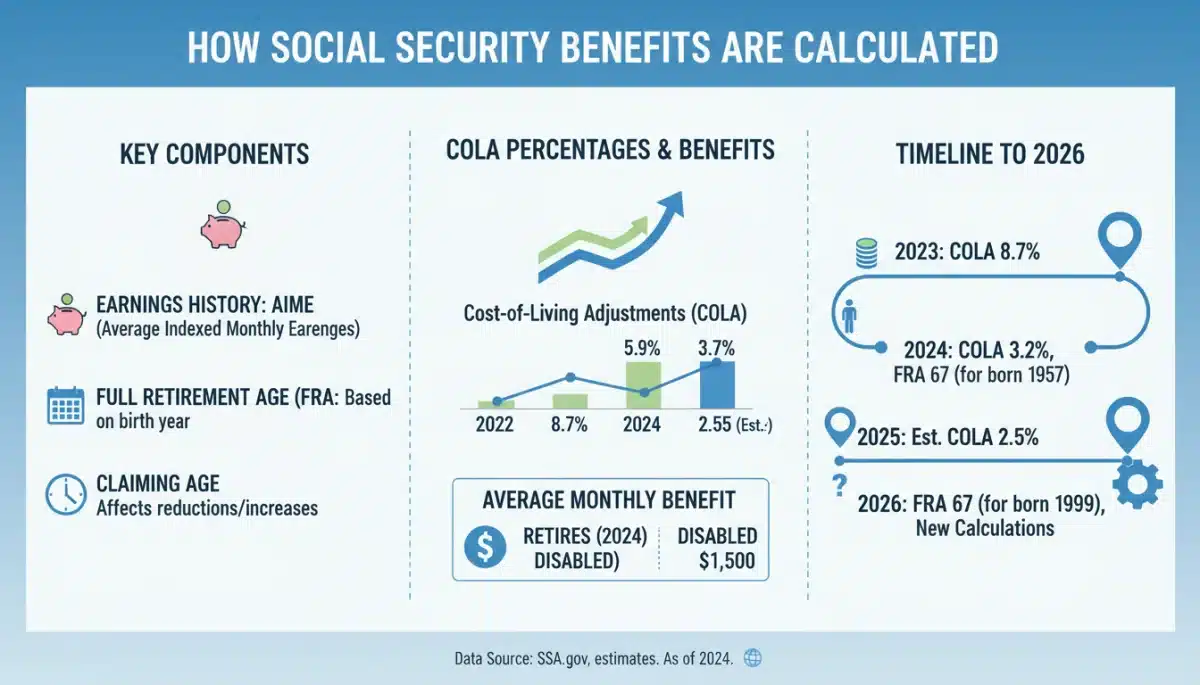
Your Social Security benefit amount isn’t arbitrary; it’s determined by a detailed formula that considers your lifetime earnings. The Social Security Administration (SSA) calculates your Average Indexed Monthly Earnings (AIME) based on your 35 highest-earning years. This AIME is then plugged into a progressive formula to arrive at your Primary Insurance Amount (PIA), which is the benefit you receive at your full retirement age.
- Indexed Earnings: Your past earnings are indexed to account for changes in general wage levels over time, ensuring your benefits reflect modern economic realities.
- Full Retirement Age (FRA): This is the age at which you are entitled to 100% of your PIA. It varies based on your birth year, gradually increasing from 65 to 67.
- Early vs. Delayed Retirement: Claiming benefits before your FRA results in a permanent reduction, while delaying beyond your FRA (up to age 70) can significantly increase your monthly payment.
Understanding these foundational elements provides a clearer picture of how any adjustments, like those anticipated for 2026, will ripple through the entire system and directly impact individual beneficiaries. These calculations are designed to be fair and equitable, yet they must also adapt to changing economic landscapes.
The Role of COLA: Cost-of-Living Adjustments
One of the most anticipated and impactful adjustments for Social Security beneficiaries is the annual Cost-of-Living Adjustment, or COLA. This mechanism is designed to protect the purchasing power of Social Security benefits against inflation. Without COLA, the fixed benefit amounts would steadily lose value over time, eroding the financial security of retirees.
The COLA is determined by changes in the Consumer Price Index for Urban Wage Earners and Clerical Workers (CPI-W). Specifically, the average CPI-W for the third quarter (July, August, and September) of the current year is compared to the average for the third quarter of the last year in which a COLA was effective. Any increase results in a corresponding COLA for the following year.
Historical COLA Trends and Future Projections
Historically, COLA percentages have varied widely, reflecting different periods of inflation and economic stability. In some years, beneficiaries have seen substantial increases, while in others, the adjustments have been minimal or even zero. The economic climate leading up to 2026 will be a critical factor in determining that year’s COLA.
- Inflationary Pressures: Higher inflation generally leads to larger COLA increases, aiming to offset rising costs for essentials like food, housing, and healthcare.
- Economic Stability: Periods of low inflation or economic stagnation often result in lower COLA percentages, which can be challenging for retirees on fixed incomes.
- Expert Forecasts: While official projections for the 2026 COLA are not yet available, economists and financial analysts often provide early estimates based on current and projected inflation rates. These forecasts can offer a preliminary glimpse into what beneficiaries might expect.
The COLA announcement, typically made in October, is always a significant event for retirees. It directly influences their monthly income and their ability to keep pace with the cost of living. For 2026, all eyes will be on economic indicators in the preceding year to gauge the potential COLA impact.
Demographic Shifts and Their Impact on Social Security
The long-term solvency of Social Security is intrinsically linked to demographic trends, particularly the changing age structure of the U.S. population. The program relies on a healthy ratio of workers contributing to the system to retirees drawing benefits. Shifts in this ratio can place significant strain on the system’s finances, necessitating adjustments.
The aging of the baby boomer generation, coupled with declining birth rates and increasing life expectancy, has led to a growing proportion of retirees relative to the working population. This demographic imbalance is a key challenge for Social Security, as fewer workers are contributing per beneficiary.
Worker-to-Beneficiary Ratio
In the mid-20th century, the worker-to-beneficiary ratio was significantly higher, with many workers supporting each retiree. Today, that ratio has decreased substantially and is projected to continue to decline. This trend means that each worker’s contributions must stretch further to cover the benefits of more retirees, putting pressure on the system.
The implications of this demographic shift are profound. It raises questions about the long-term sustainability of current benefit levels and contribution rates. Policy discussions often revolve around potential solutions, including adjustments to the full retirement age, changes to the benefit formula, or modifications to the payroll tax rate.
For the 2026 adjustments, while direct demographic changes won’t alter the COLA formula, the broader demographic context influences legislative debates and the overall health of the trust funds. These discussions can lead to other statutory changes that might affect beneficiaries indirectly, even if their monthly checks primarily adjust due to COLA.
Legislative Proposals and Potential Reforms for 2026
Social Security is a dynamic program, constantly subject to legislative scrutiny and proposals for reform. As the program faces long-term financial challenges, policymakers frequently introduce ideas to ensure its solvency and adapt it to modern economic and demographic realities. These legislative discussions could directly influence the 2026 adjustments beyond the automatic COLA.
While the COLA is an automatic annual adjustment, other aspects of Social Security benefits, such as the full retirement age, the earnings limit, or the taxation of benefits, require congressional action. Debates often center on how to balance the needs of current and future retirees with the financial health of the trust funds.
Key Areas of Potential Reform
Several areas are frequently discussed when it comes to Social Security reform. Understanding these potential changes can help beneficiaries anticipate what might be on the horizon for 2026 and beyond.
- Raising the Full Retirement Age: One common proposal is to gradually increase the full retirement age further, reflecting increased life expectancy. This would mean individuals would have to work longer to receive their full benefits.
- Adjusting the COLA Formula: Some proposals suggest changing the index used for COLA calculations, such as switching from the CPI-W to the Chained CPI. This could result in slightly lower annual increases.
- Increasing the Taxable Earnings Cap: Currently, there’s a cap on the amount of earnings subject to Social Security taxes. Raising or eliminating this cap would increase revenue for the program.
- Modifying Benefit Formulas: Changes to the progressive benefit formula could alter how benefits are calculated for future retirees, potentially affecting higher earners more significantly.
It’s important to note that any significant legislative changes typically require broad bipartisan support, which can be challenging to achieve. However, the ongoing financial projections for the Social Security trust funds ensure that these discussions remain a priority. Beneficiaries should stay informed about these potential reforms as they could significantly alter the landscape of Social Security benefits in 2026 and subsequent years.
Financial Planning for Future Social Security Beneficiaries
For those currently receiving benefits and those approaching retirement, understanding the potential Social Security 2026 adjustments is paramount for robust financial planning. While some aspects of Social Security are fixed, beneficiaries have a degree of control over how they maximize their benefits and integrate them into their overall retirement strategy.
Proactive financial planning involves not only anticipating changes but also making informed decisions about when to claim benefits, how to manage other retirement income sources, and how to adapt to evolving economic conditions. The goal is to build a resilient financial future that can withstand potential shifts in the Social Security landscape.
Strategies for Maximizing Benefits
There are several key strategies individuals can employ to optimize their Social Security benefits, regardless of future adjustments:
- Delaying Claiming: As mentioned, delaying benefits past your full retirement age can significantly increase your monthly payment, up to age 70. This strategy can provide a higher guaranteed income stream later in life.
- Understanding Spousal Benefits: If married, coordinating claiming strategies with your spouse can maximize the total benefits received by the household.
- Working Longer: Continuing to work, even part-time, can replace lower-earning years in your AIME calculation, potentially increasing your overall benefit.
- Reviewing Your Earnings Record: Regularly check your Social Security earnings record for accuracy. Errors can impact your benefit calculations.
Beyond Social Security, it’s crucial to diversify your retirement income sources. Relying solely on Social Security can be risky, especially with potential future adjustments. Pensions, 401(k)s, IRAs, and personal savings accounts all play a vital role in creating a comprehensive retirement plan. Integrating Social Security benefits with these other sources allows for greater flexibility and security. Staying informed about economic forecasts, inflation rates, and legislative developments will enable you to make timely adjustments to your financial plan, ensuring you are well-prepared for any changes that 2026 and beyond may bring.
The Economic Outlook Leading to 2026 and Beyond
The economic environment plays a pivotal role in shaping Social Security adjustments, particularly the COLA. Factors such as inflation rates, wage growth, and unemployment levels directly influence the health of the Social Security trust funds and the purchasing power of benefits. As we look towards 2026, understanding these broader economic trends is essential for anticipating the nature of upcoming changes.
Current economic forecasts suggest a period of continued vigilance regarding inflation, although projections vary. Sustained high inflation could lead to more substantial COLA increases, while a return to lower, more stable inflation might result in smaller adjustments. Wage growth is also critical, as it impacts the revenue flowing into the Social Security system through payroll taxes.
Inflation and Wage Growth Projections
Economists are closely monitoring several indicators that will influence the 2026 COLA and the overall financial picture for Social Security:
- Consumer Price Index (CPI): The CPI-W, specifically, is the metric used for COLA. Its trajectory in 2025 will be the primary determinant for the 2026 adjustment.
- Labor Market Strength: A strong labor market with consistent wage growth ensures a steady stream of payroll tax contributions, which is vital for the system’s solvency.
- Interest Rates: The Federal Reserve’s monetary policy and prevailing interest rates can affect the trust funds’ investment earnings, though these are a smaller component of overall funding.
The interplay of these economic forces creates a complex picture. While beneficiaries hope for robust COLAs to maintain their purchasing power, sustained high inflation can also erode savings and increase living expenses. Therefore, a balanced economic environment is generally most favorable for both the Social Security system and its recipients.
Looking beyond 2026, the long-term economic outlook will continue to influence policy decisions regarding Social Security. Sustainable economic growth, coupled with thoughtful demographic planning, will be key to ensuring the program’s viability for future generations of retirees. Staying informed about these macroeconomic trends is an integral part of preparing for retirement.
| Key Point | Brief Description |
|---|---|
| 2026 COLA | Anticipated cost-of-living adjustment to combat inflation, based on 2025 CPI-W data. |
| Beneficiary Impact | Over 65 million retirees and other beneficiaries will see direct changes to their monthly payments. |
| Demographic Pressure | Aging population and declining birth rates continue to challenge the worker-to-beneficiary ratio. |
| Legislative Outlook | Ongoing discussions about potential reforms, including retirement age and taxable earnings cap. |
Frequently asked questions about Social Security 2026 Adjustments
The main driver for Social Security 2026 adjustments will be the Cost-of-Living Adjustment (COLA). This annual increase is determined by changes in the Consumer Price Index for Urban Wage Earners and Clerical Workers (CPI-W) during the third quarter of 2025, aiming to protect beneficiaries’ purchasing power from inflation.
The 2026 adjustments are anticipated to affect over 65 million retirees and other Social Security beneficiaries. This includes individuals receiving retirement, disability, and survivor benefits, all of whom will see their monthly payments adjusted based on the new COLA and any other statutory changes.
The official Cost-of-Living Adjustment (COLA) for 2026 is typically announced in October of the preceding year, meaning October 2025. This announcement provides beneficiaries with advance notice of the percentage increase that will be applied to their Social Security payments starting in January 2026.
Yes, alongside the automatic COLA, legislative actions could potentially impact 2026 Social Security benefits. Debates around the program’s long-term solvency often lead to proposals concerning the full retirement age, taxable earnings cap, or benefit calculation formulas, which might be enacted by 2026.
Retirees can prepare by staying informed about economic forecasts and legislative discussions. It’s also wise to review personal financial plans, diversify income sources beyond Social Security, and consider strategies like delaying claiming benefits if possible, to maximize their overall retirement security.
Conclusion
The upcoming Social Security 2026 adjustments represent a critical juncture for over 65 million retirees and future beneficiaries. While the annual Cost-of-Living Adjustment (COLA) remains the most direct and anticipated change, the broader context of demographic shifts, economic conditions, and ongoing legislative debates will collectively shape the future of this vital program. Proactive financial planning, coupled with a keen awareness of these evolving factors, empowers individuals to navigate the complexities of Social Security and secure their retirement. Staying informed and adapting strategies will be key to ensuring that Social Security continues to provide a dependable foundation for millions of Americans.
