Unemployment Benefits 2026: State-Specific Eligibility & Programs
Advertisers
This guide provides a comprehensive overview of unemployment benefits in 2026, detailing state-specific eligibility criteria, the nuances of extended unemployment programs, and offering practical solutions for those navigating job loss across the United States.
Facing job loss can be a daunting experience, filled with uncertainty about financial stability. Understanding if you are eligible for unemployment benefits in 2026 is crucial for navigating these challenging times. This comprehensive guide will illuminate the complexities of state-specific unemployment programs and extended benefits, offering practical solutions to help you secure the support you need.
Understanding the Basics of Unemployment Benefits in 2026
Unemployment benefits serve as a vital safety net for individuals who lose their jobs through no fault of their own. As we look towards 2026, the fundamental principles of these programs remain consistent, yet the specifics can vary significantly from state to state. It’s essential to grasp these core concepts to effectively assess your eligibility and understand the scope of available assistance.
Generally, unemployment insurance is a joint state-federal program that provides temporary financial assistance to unemployed workers. These benefits are not an entitlement based on need, but rather a form of insurance funded by employer contributions. The primary goal is to provide a temporary, partial wage replacement to help individuals cover basic living expenses while they actively search for new employment.
Anúncios
Key Eligibility Criteria Across States
While each state has its own unique set of rules, several common criteria determine eligibility for unemployment benefits. Meeting these foundational requirements is the first step in securing assistance.
- Monetary Eligibility: Applicants must have earned a certain amount of wages during a specific period, known as the ‘base period,’ typically the first four of the last five completed calendar quarters before filing a claim.
- Reason for Separation: You must have lost your job through no fault of your own. This generally means you were laid off, your position was eliminated, or you were discharged for reasons other than misconduct.
- Availability and Search for Work: Claimants must be able to work, available for work, and actively seeking new employment. States often have specific requirements for documenting job search efforts.
Understanding these basic requirements is the bedrock of navigating the unemployment system. Even minor discrepancies in meeting these criteria can lead to delays or denials, making thorough preparation and accurate reporting paramount.
State-Specific Eligibility Requirements: What to Expect in 2026
While federal guidelines provide a framework, the true complexity of unemployment benefits lies in their state-specific nature. Each state has the authority to set its own unique rules regarding eligibility, benefit amounts, duration, and even the application process. For 2026, it’s critical to research the specific regulations of the state where you worked and earned wages.
These variations can be substantial. For instance, the minimum earnings required in the base period can differ widely, as can the definition of ‘misconduct’ that might disqualify an applicant. Some states might have more stringent job search requirements, demanding a certain number of applications per week, while others might focus more on participation in reemployment services.
Anúncios
Navigating State-Specific Nuances
To illustrate the diversity, consider the following aspects that vary by state:
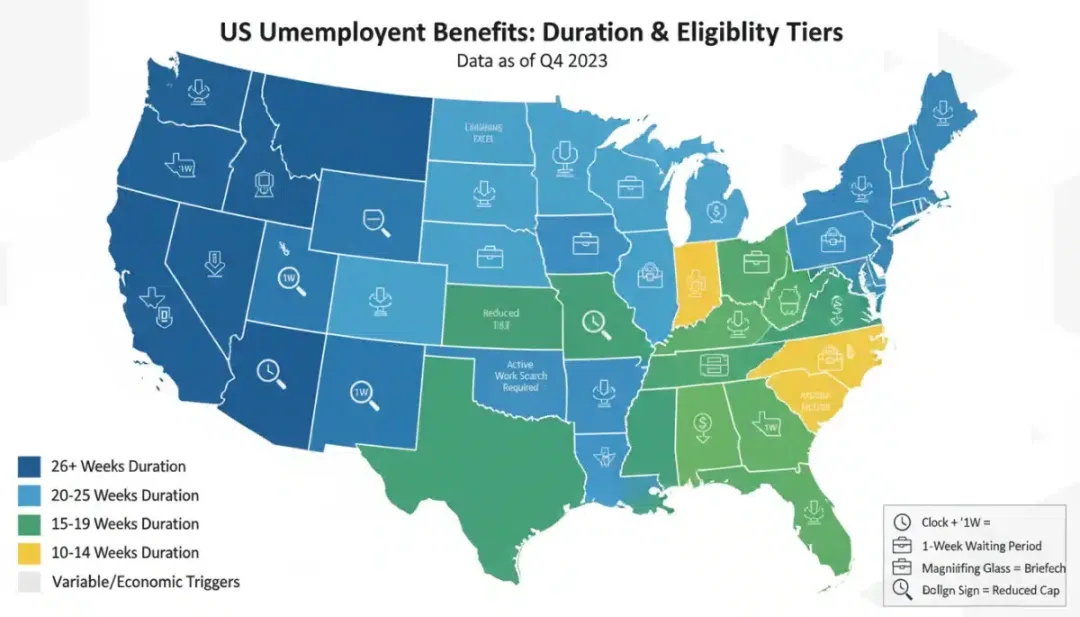
- Waiting Period: Some states impose a one-week waiting period before benefits begin, meaning you won’t receive payment for the first week of unemployment. Other states have eliminated this.
- Benefit Duration: The standard duration for regular unemployment benefits is 26 weeks in most states, but some offer fewer (e.g., Florida, North Carolina) or more (e.g., Massachusetts).
- Weekly Benefit Amount (WBA): This is typically calculated as a percentage of your average weekly wages during your base period, up to a state-defined maximum. These maximums vary significantly, from a few hundred dollars to over a thousand in some high-cost-of-living states.
Therefore, a worker moving from one state to another might find their eligibility and benefit amount drastically different, even with similar work histories. It is imperative to consult your state’s Department of Labor or equivalent agency website for the most accurate and up-to-date information for 2026.
Extended Unemployment Programs: When Regular Benefits Aren’t Enough
Under normal economic conditions, regular state unemployment benefits provide a limited period of financial support. However, during periods of high unemployment or economic downturns, federal and state governments may implement extended unemployment programs. These programs are designed to provide additional weeks of benefits once an individual has exhausted their regular state benefits.
In 2026, the availability of extended benefits will largely depend on economic indicators and legislative actions. The primary federal program for extended benefits is Extended Benefits (EB), which is triggered when a state’s insured unemployment rate (IUR) reaches certain thresholds. The EB program provides up to an additional 13 or 20 weeks of benefits, depending on the state’s unemployment rate.
Understanding Extended Benefit Triggers
The triggers for Extended Benefits are complex and tied to state-specific economic conditions. Here’s a simplified breakdown:
- High Unemployment Rate: If a state’s IUR is at least 5% and is 120% of the average IUR for the corresponding 13-week period in the preceding two years, EB can be triggered.
- Higher Unemployment Rate: If a state’s IUR is at least 6%, EB can also be triggered, even if the 120% threshold isn’t met.
- Duration: The duration of EB benefits (13 or 20 weeks) depends on how high the state’s IUR is relative to these thresholds.
It’s important to note that these programs are not permanent fixtures and are activated or deactivated based on current economic data. Claimants typically do not need to reapply for EB; they are usually automatically transitioned if they meet the criteria and the program is active in their state. Staying informed about economic trends and legislative updates will be key to understanding the potential availability of extended benefits in 2026.
Practical Solutions for Claiming and Managing Your Benefits
Navigating the unemployment system can be challenging, but adopting a strategic approach can significantly streamline the process and ensure you receive the benefits you’re entitled to. From the initial application to ongoing management, being organized and proactive is key.
The first step is always to file your claim as soon as you become unemployed. Delays can result in lost benefits, as most states do not backdate claims beyond the week you initially apply. Gather all necessary documentation beforehand, including your Social Security number, driver’s license or state ID, employment history for the past 18 months (including employer names, addresses, and dates of employment), and reasons for separation.
Tips for a Smooth Application Process
To ensure a successful claim, consider these practical tips:
- Accurate Information: Double-check all information before submitting your application. Errors can lead to delays or denials.
- Be Honest: Provide truthful and complete information. Misrepresentation can lead to serious penalties, including disqualification and repayment of benefits.
- Keep Records: Maintain a detailed log of all communications with the unemployment office, including dates, times, names of representatives, and summaries of conversations.
- Document Job Search: Keep meticulous records of your job search activities, as you will likely be required to report them weekly or bi-weekly. This includes dates of contact, company names, job titles, and outcomes.
Managing your benefits effectively also involves understanding your responsibilities, such as reporting any earnings from part-time work or severance pay, as these can affect your weekly benefit amount. Remaining diligent in your job search and fulfilling all reporting requirements will help ensure a continuous flow of benefits while you seek new employment.
Special Considerations: Self-Employment, Gig Workers, and Part-Time Employment
The traditional unemployment insurance system was primarily designed for W-2 employees. However, the modern workforce includes a growing number of self-employed individuals, gig workers, and those in part-time roles. Understanding how unemployment benefits apply to these groups in 2026 requires a closer look at evolving state and federal policies.
Historically, self-employed individuals and independent contractors were not eligible for regular unemployment benefits because their earnings were not subject to unemployment taxes. During economic crises, temporary federal programs have sometimes extended benefits to these groups, but these are not typically permanent. For 2026, eligibility for these workers will depend heavily on whether any specific state or federal legislation is in place to cover them.
Navigating Non-Traditional Employment and Benefits
For those in non-traditional employment, here are key points to consider:
- State-Specific Programs: Some states are exploring or have implemented programs that offer limited unemployment-like benefits to self-employed individuals, often tied to specific industries or situations.
- Part-Time Work: If you are working part-time, you might still be eligible for partial unemployment benefits. Most states allow claimants to earn a certain amount of money without reducing their benefits, or they reduce benefits by a percentage of earnings over a threshold. It is crucial to report all earnings.
- Misclassification: Some workers are misclassified as independent contractors when they should legally be employees. If you believe you were misclassified, you might be eligible for regular unemployment benefits, but this often requires an investigation.
The landscape for non-traditional workers and unemployment benefits is continually evolving. It is advisable for self-employed individuals and gig workers to proactively research their state’s specific provisions and consider alternative income protection strategies, as traditional unemployment insurance may not cover them in 2026 without specific legislative action.
Appealing a Denial and Seeking Further Assistance
Receiving a denial for unemployment benefits can be disheartening, but it is not always the final word. Claimants have the right to appeal decisions they believe are incorrect. The appeals process is a critical safeguard designed to ensure fair consideration of all claims. Understanding this process and knowing where to seek additional help can significantly improve your chances of overturning an initial denial.
Most states have a multi-level appeals process. The first step typically involves filing an appeal request within a specified timeframe (usually 10-30 days from the date of the decision). This often leads to a hearing, which may be conducted by phone, video conference, or in person, before an administrative law judge or hearing officer. During this hearing, you will have the opportunity to present your case, provide evidence, and question witnesses.
Steps in the Appeals Process
To successfully navigate an appeal, consider these actions:
- Review the Denial Letter: Understand the specific reasons for the denial. This will help you prepare your arguments and gather relevant evidence.
- Gather Evidence: Collect all documents that support your claim, such as employment contracts, termination letters, performance reviews, and any communication with your former employer.
- Seek Legal Aid: Consider contacting legal aid services or a lawyer specializing in employment law. Many offer free consultations or services on a sliding scale.
- Prepare Your Testimony: Be clear, concise, and factual when presenting your case. Practice what you want to say and be ready to answer questions.
If the initial appeal is unsuccessful, further appeals to higher administrative bodies or even state courts may be possible. Additionally, various non-profit organizations and government agencies offer free resources and guidance for those navigating unemployment. Do not hesitate to seek assistance if you feel overwhelmed or unsure about the process.
| Key Aspect | Brief Description |
|---|---|
| Eligibility Basics | Must have sufficient past earnings, lost job through no fault, and be available/actively seeking work. |
| State Variations | Rules for waiting periods, benefit duration, and weekly amounts differ significantly by state. |
| Extended Benefits | Federal program (EB) triggered by high state unemployment rates, offering additional weeks. |
| Application Tips | Apply promptly, provide accurate info, keep records, and document job search efforts diligently. |
Frequently Asked Questions About 2026 Unemployment Benefits
What is the ‘base period’ for unemployment benefits in 2026?▼The base period is typically the first four of the last five completed calendar quarters before you filed your unemployment claim. States use this period to calculate if you earned enough wages to qualify for benefits and to determine your weekly benefit amount. It’s crucial to have sufficient earnings during this time.
Can I receive unemployment benefits if I quit my job in 2026?▼Generally, no. To be eligible for unemployment benefits, you must have lost your job through no fault of your own. If you quit voluntarily, you are usually disqualified unless you had a ‘good cause’ reason, such as unsafe working conditions or constructive discharge, which varies by state law.
How long do unemployment benefits last in 2026?▼The duration of regular state unemployment benefits varies, but it is typically up to 26 weeks in most states. Some states offer fewer weeks, while a few offer more. Extended benefits (EB) may provide additional weeks during periods of high unemployment, depending on state economic triggers.
Do I have to look for a job while receiving unemployment?▼Yes, in almost all states, a condition for receiving unemployment benefits is that you must be able to work, available for work, and actively searching for new employment. States have specific requirements for job search activities, which you will need to document and report regularly to continue receiving benefits.
What if my unemployment claim is denied?▼If your unemployment claim is denied, you have the right to appeal the decision. You typically have a limited timeframe (e.g., 10-30 days) to file an appeal. During the appeal process, you can present your case and provide evidence to support your eligibility. It is advisable to gather all relevant documentation and seek legal assistance if needed.
Conclusion
Navigating the landscape of unemployment benefits in 2026 requires a clear understanding of state-specific regulations and available programs. While the core purpose of unemployment insurance remains constant—providing a temporary financial bridge during job loss—the nuances of eligibility, benefit amounts, and duration are deeply rooted in individual state laws. By proactively researching your state’s requirements, meticulously preparing your application, and understanding the potential for extended benefits, you can better position yourself to receive the support you need. Remember, unemployment benefits are a critical safety net, and being informed is your most powerful tool in securing your financial stability during times of transition.